Winter guide
Cold walls and condensation?
Meet peel-and-stick insulation wallpaper.
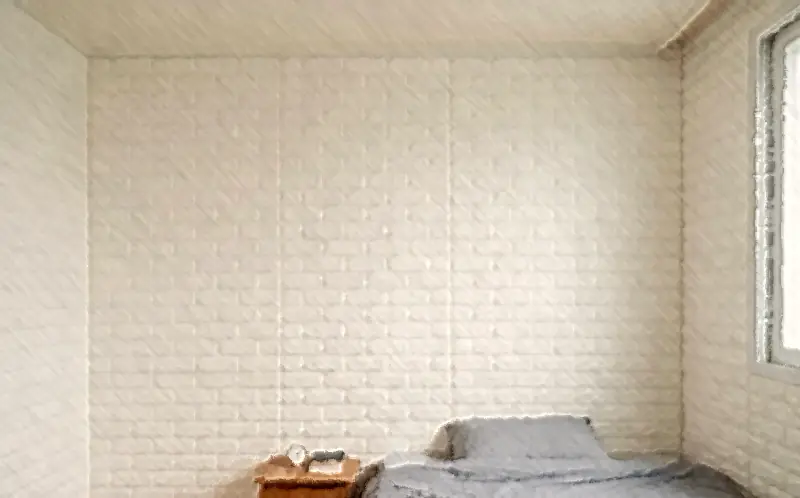
A room can feel cold even with the heating on — often because of the walls themselves. QONE's insulation wallpaper sticks straight onto your existing wall and adds an air-filled foam layer between your room and the cold surface.
Why do walls get condensation?
When warm, humid indoor air touches a wall chilled by the outside air, the water vapour in that air turns into droplets. Exterior walls, north-facing rooms, the space behind furniture and the area around windows are coldest — and if left alone, that moisture leads to mould and musty smells.
Three ways insulation wallpaper helps
Note: condensation depends on room temperature, humidity, ventilation and how the building is constructed. Insulation wallpaper makes condensation less likely — it does not make it impossible. Combine it with regular ventilation and dehumidifying.
Inside the 8 layers
| Layer | What it does |
|---|---|
| 1 Transparent film | Protects the printed surface |
| 2 Printed layer | Pattern and color |
| 3 PE layer | Bonds and stabilizes |
| 4 PE foam sheet | The insulating, sound-softening core |
| 5 PE layer | Bonds and stabilizes |
| 6 Aluminum film | Reflects heat, blocks damp from the wall |
| 7 Adhesive layer | Self-adhesive — no glue needed |
| 8 Release film | Peel off and stick on |
See the layers come apart in the 3D viewer on our homepage.
Where to use it
- Exterior walls of north-facing rooms — no sun, the coldest surface in the house.
- Below and around windows — cold air sinks here and chills your feet.
- Behind beds and sofas — where you spend the most time with your back to the wall.
- Kids' rooms — the soft foam also cushions bumps against the wall.
How to install (4 steps)
- Wipe the wall free of dust, grease and moisture, and let it dry completely.
- Measure the area and cut the wallpaper to size with a utility knife or scissors.
- Peel the backing a little at a time from the top, aligning the top edge as you go.
- Smooth from the center outward with your palm to push out air and press it firmly in place.
Step-by-step photos are in our installation guide; for the difference from ordinary wallpaper, read this comparison.
Before you start
- For indoor use only — not for outdoor walls, showers or areas that get wet.
- Keep away from open flames and heat sources such as heaters and stoves.
- Will not bond well to heavily textured walls, water-repellent or flame-retardant coated wallpaper, or slick surfaces.
- Removing the product may damage the wall surface underneath. Renters should check with the landlord first and test in an inconspicuous spot.
- Keep small children from chewing or peeling the panels.
Products for cold, damp walls
Frequently asked questions
Will insulation wallpaper completely stop condensation?
It keeps the wall surface warmer, which makes condensation less likely, but humidity and ventilation still matter. Use it together with ventilation and a dehumidifier.
Can I put it over my existing wallpaper?
Yes, on flat, dry surfaces such as standard vinyl wallpaper. It will not bond well to heavily textured walls, water-repellent or flame-retardant coated wallpaper, or slick surfaces.
Is it suitable for renters?
Removing it may damage the wall surface underneath. Check with your landlord first and test in an inconspicuous spot.
Is it safe?
Our products were tested by KATRI, a Korean testing and research institute, and 6 heavy metals were not detected. See what KATRI testing means.
Can retailers buy wholesale or private label?
Yes. We sell wholesale and develop OEM / private label versions for retailers and online sellers. WhatsApp us or email chl@qone.kr.
Talk to the factory directly.
WhatsApp or email (chl@qone.kr). Samples, quotes, wholesale and OEM — usually answered within 24 hours.